
Why You Should Not Sweat While Resistance Training!
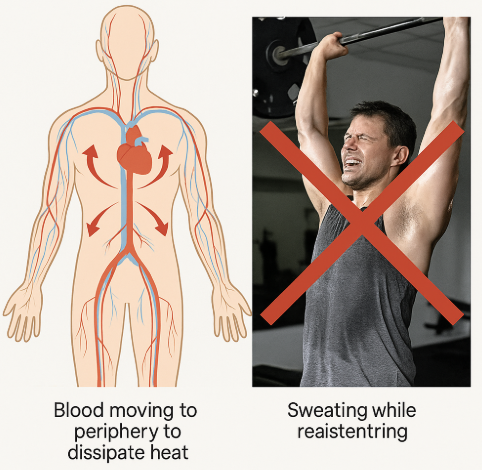
For decades, sweat has been celebrated as proof of a good workout. The more you sweat, the harder you worked — or so we thought. Modern exercise physiology shows the opposite: sweating is a sign of inefficiency, not effectiveness, especially in resistance training.
When you sweat, your body is trying to cool itself. To achieve this, blood is redirected away from your muscles to your skin to release heat. In fact, up to 50% of your blood flow can shift to the periphery before you even begin to sweat. This diversion means your working muscles receive less oxygen, fewer nutrients, and fewer building blocks for protein synthesis — all of which are essential for muscle growth.
As the muscle’s internal temperature rises, enzymatic activity linked to energy metabolism and protein repair becomes impaired. The result? Faster fatigue, lower power output, and slower muscle recovery. Over time, this heat stress can limit progress, even if you train consistently.
Stanford Professor H. Craig Heller and his research team demonstrated that cooling muscles during or between strength sessions can dramatically enhance performance. By extracting heat from the body’s natural “radiator zones” — the palms, soles, and face — they found athletes could perform more work, recover faster, and gain strength more efficiently than through traditional high-sweat training.
In practical terms, that means you build more muscle by staying cool. Efficient strength training happens when your nervous system, muscles, and energy metabolism are all focused on lifting — not cooling.
At TomFit, we put this science into practice. Our training environment and equipment are designed to maintain ideal muscle temperature for maximum activation, faster recovery, and real growth — without the sweat.
Scientific References
- H. Craig Heller | Department of Biology Performance enhancement with controlled cooling: the physiology of heat extraction. Stanford University, Department of Biology, 2012. https://pubmed.ncbi.nlm.nih.gov/22076097/
Stanford researchers' cooling glove 'better than steroids'
https://journals.lww.com/nsca-jscr/Fulltext/2012/09000/Work_Volume_and_Strength_Training_Responses_to.33.aspx - Périard, J. D., Eijsvogels, T. M. H., & Daanen, H. A. (2021). Exercise under heat stress: thermoregulation, hydration, performance implications, and mitigation strategies. Physiological Reviews, 101(4), 1873-1979. DOI:10.1152/physrev.00038.2020. Available via PubMed: https://pubmed.ncbi.nlm.nih.gov/33829868/ PubMed+1
- Grahn DA, Cao VH, Heller HC. “Work volume and strength training responses with thermal extraction.” Journal of Applied Physiology, 2012; 112(11): 1797–1804.
https://pubmed.ncbi.nlm.nih.gov/22076097/ - Kenny GP, et al. “Heat stress and exercise performance: physiological mechanisms and implications for human health.” Physiological Reviews, 2022; 102(4): 1627–1680.
https://pubmed.ncbi.nlm.nih.gov/35020830/